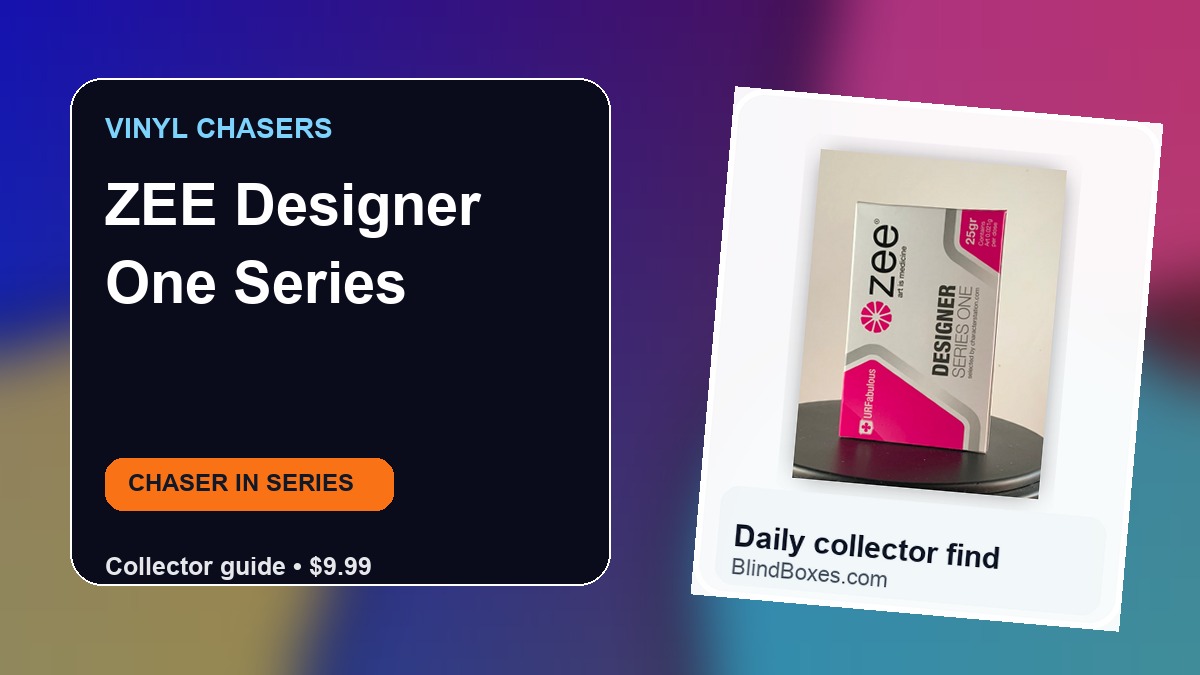
ZEE Designer One is the kind of late-2000s art toy that rewards reading the package as closely as studying the figure. Created for Geneva-based Urfabulous in 2008, the 2.5-inch platform turns a compact, flared-body character into a mock pharmaceutical product. The carton says art is medicine; dosage-style graphics, a faux instruction leaflet, and clinical warnings carry the joke far beyond a logo on a blind box.

A Geneva art toy with a complete fictional treatment plan
The surviving French instruction sheet identifies Urfabulous at Boulevard Saint-Georges in Geneva as producer and dates its revision to September 2008. It describes a 45-gram rotocast vinyl figure containing 44.979 grams of vinyl and a tongue-in-cheek 0.021 grams of “art radiation.” The same sheet specifies a 2.5-inch figure in 12 color variants, plus three special treatments: black, gray, and phosphorescent. That is much more specific than the usual “collect them all” copy and makes the insert an important part of a complete example.
The medical parody continues into display instructions. Owners are told to free the figure from its blister, position it in an appropriate place, contemplate it, and clean it weekly with an antistatic cloth. None of that is ordinary care guidance dressed up after the fact; it is the central concept. The package front reinforces it with “25gr,” “per dose,” and “art is medicine,” while the side marks the piece as an adult collectible.
Nine named ZEE personalities
The insert gives nine main designs individual names and supposed “properties.” They are Toxic by Nathalie Oswald, Eat Me by Denis Hérisson, Femdom-Zeex by Dr. Acid, Metamo by Nathalie Oswald, Reptile by Cruz, Graffiti Grenade by Flying Förtress, CharacterStation by Geoffrey Baumbach, Vingtneuf Degrés by Sady, and Fetish by Denis Hérisson. Each receives a different mock effect, from heightened creativity to psychedelia or metamorphosis.
An archived CharacterStation product page adds useful scale and edition context for one release: its Flying Förtress “Graffiti Grenade” ZEE was listed at 6.5 cm and limited to 1,111 pieces. That quantity should be treated as documentation for that specific design, not automatically multiplied into a verified total for every color and special treatment.
The secret figure and the 10-inch prize
One side of the photographed box challenges buyers to find a one-of-a-kind secret figure and win an ultra-rare 10-inch ZEE by PIX. No numerical pull odds are printed in the available photographs, and the 10-inch piece is the prize rather than the standard blind-box figure. In collector language, the unique secret pull can reasonably be described as a chaser because the package itself establishes exceptional scarcity. It is not presented as an official capital-C “Chase” designation, and collectors should not confuse the secret with the prize it unlocked.
What to inspect on a boxed example
The current product photographs show all four sides of the original magenta, silver, and white carton, including the assortment panel and safety copy, but they do not reveal the figure inside. The pictured box has light edge and flap wear rather than severe crushing. For a collection-grade purchase, compare the exact carton shown, ask whether the inner blister and French instruction sheet are present, and do not infer a particular design from the outer box alone. A complete opened example can still have strong display value because the leaflet is where the series’ names, variants, and art-medicine fiction are documented.
At $9.99, ZEE Designer One is an accessible route into a specifically Swiss chapter of the 2008 designer-toy scene. Its attraction is not a licensed character or a modern rarity chart; it is the combination of a compact platform, a multi-artist lineup, unusual packaging theater, and a documented secret-figure promotion.