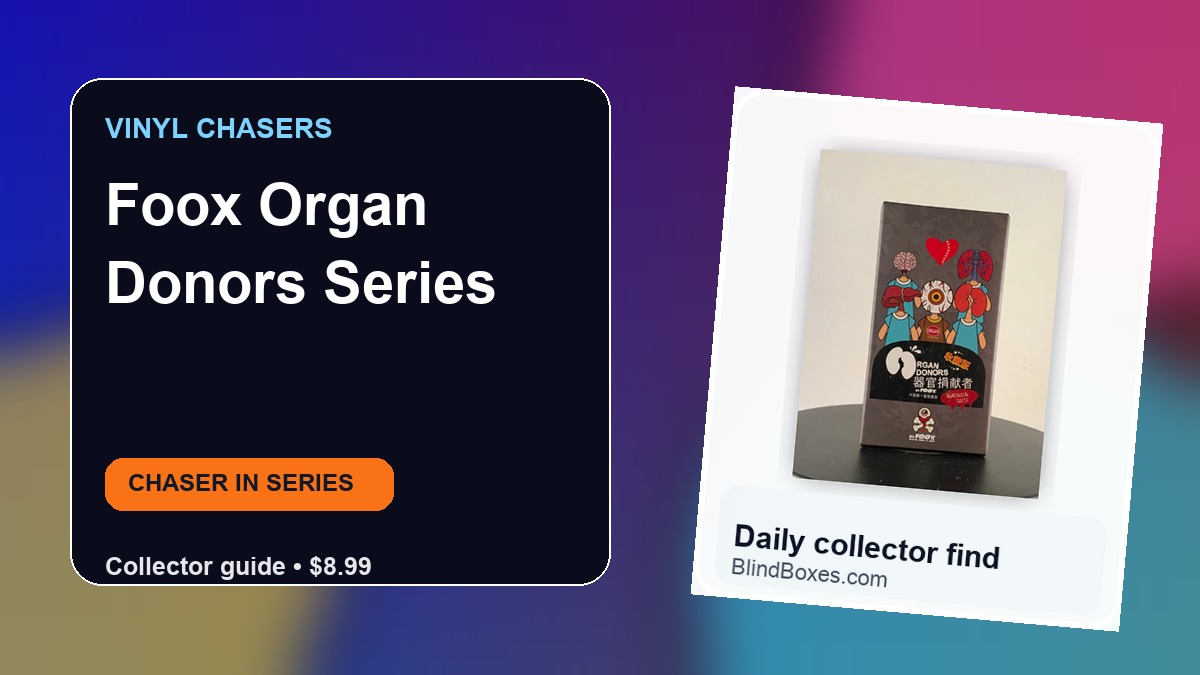
Foox Organ Donors is the kind of designer-vinyl concept that makes its point before the box is even opened: a hospital-gowned body receives a cartoon organ for a head. David Foox introduced the line in 2009 as both a blind-box collection and a playful way to raise awareness of organ donation. The result is a compact series with a much more specific identity than a generic mystery figure.
Nine organs, 24 characters
The original Foox material describes a 24-character assortment built around nine organ families: kidneys, brains, stem cells, blood cells, plasma, heart, liver, eyeball/cornea, and lungs. These are not simply 24 unrelated sculpts. The organizing idea is a shared hospital-gown body paired with different anatomical heads and color treatments, which makes the set read as one deliberately constructed world.
The archived 2009 product page specifies a 3.25-inch vinyl figure with five points of articulation. It also calls the assortment 24 colorways across the nine organ types. That scale places Organ Donors firmly in the small designer-vinyl blind-box tradition: large enough for the head sculpt and transparent or unusual color treatments to matter, but compact enough to display as a group.
What makes a pull rare?
Rarity was part of Organ Donors from the beginning. Foox’s own launch copy says that some characters were rarer than others and that some were “super rare.” The original product page names Black Market Kidneys and Pickled Liver as examples of rarer versions. That is enough to treat documented short-packed designs as collector-described chasers or chase-level pulls, but there is no evidence that Foox used an official capital-C “Chase” designation for the line.
The bilingual box photographed for this product adds another mystery cue: one panel shows six illustrated organ-headed figures and a seventh black silhouette marked with a question mark. No numerical pull ratios are visible in the supplied photographs, so collectors should not assign odds to that silhouette or assume which character it represents.
The 2009 release and later China-only context
Foox announced the standard assortment for shipment in March 2009, while an official June update recorded that the figures had arrived and that complete sets quickly sold out even though singles and trays remained available. The box itself carries “Organ Donors,” “By Foox,” the phrase “Anatomical Gifts,” bilingual English/Chinese branding, a collector-edition marking, and logos for Foox and ESC-Toy. It is also marked for ages 15 and up and describes the contents as a collectible rather than a toy.
There is an important adjacent release to know about without confusing it with every bilingual box. In August 2009, Foox previewed a China-only “One Heart” special release planned for October. That super-rare figure was described with a red heart head and a gold dragon on its hospital gown, celebrating the 60th anniversary of the People’s Republic of China. The surviving packaging photos here do not prove that a sealed box contains One Heart, so the special should be treated as series context, not a promised pull.
How to evaluate a sealed Organ Donors box
For a sealed example, the packaging is a meaningful part of the collectible. Check that the top and bottom flaps have not been opened or re-taped, inspect the dark printed panels for crushing or moisture wear, and compare the bilingual Foox/ESC-Toy marks with known photographs. A clean box preserves the blind-box experience; opening it trades that intact package for the certainty of identifying the figure and checking its joints, paint, transparent parts, and hospital gown.
Collectors building a full display should track both the organ family and the colorway rather than recording a pull simply as “Heart” or “Kidney.” With 24 characters spread across nine categories, organ type alone does not uniquely identify a figure. Original names such as Black Market Kidneys, Pickled Liver, and Homegrown Stem Cell are more useful whenever the exact variant can be established.
Why the series still stands out
Organ Donors combines a clear social idea, a coherent body system, and the oddball humor of exposed brains, eyeballs, lungs, and stitched hearts wearing hospital gowns. Its strongest collector appeal is not just that a box is mysterious; it is that every possible pull belongs to a tightly defined anatomical concept from a documented 2009 designer-vinyl release.