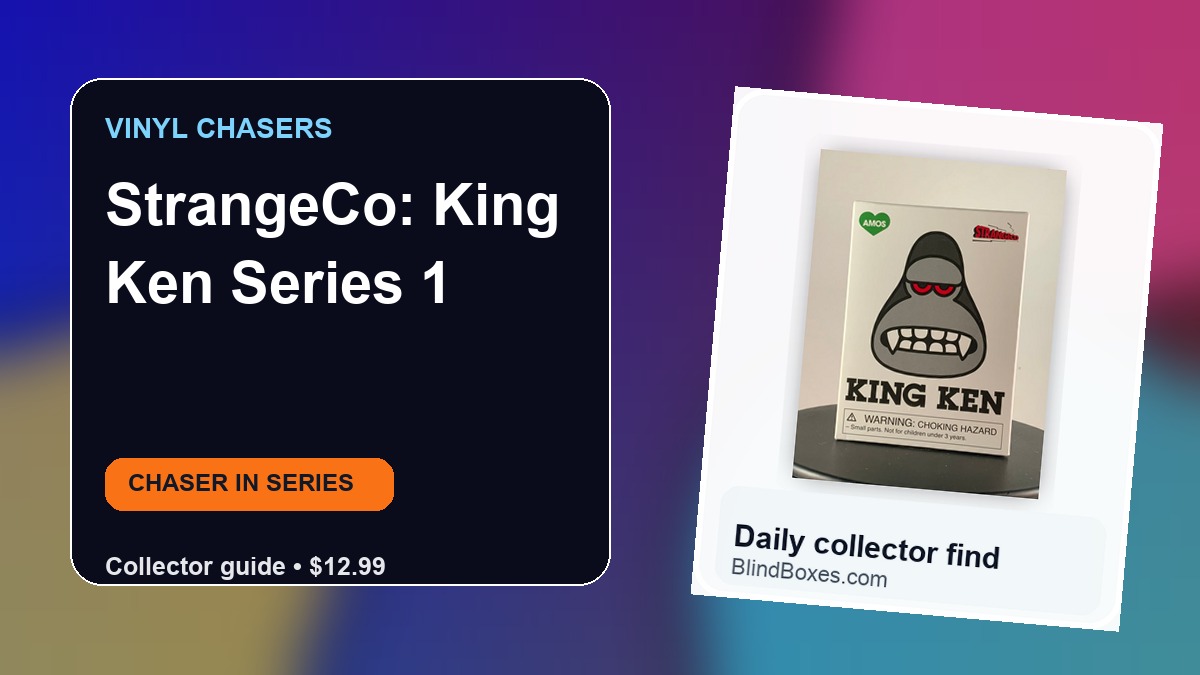
Mini King Ken Series 1 compresses one of James Jarvis’s most recognizable characters into a compact blind-box format without changing the character’s wonderfully confrontational expression. Every pull uses the same hunched gorilla body, broad chest, long arms, red-eyed stare, and oversized teeth; the collecting challenge comes from the color treatment and one concealed design.
The carton carries the AMOS and STRANGEco marks, and its legal panel is especially useful for dating the release: it is copyright 2008 Amos Novelties Ltd. and says it was produced and distributed by Strange Collective in San Francisco. A contemporary secondary-market catalog identifies these as approximately 3-inch designer figures and attributes King Ken to James Jarvis. Kidrobot’s later announcement for Series II independently calls Jarvis the creator of Amos Toys and describes King Ken as his iconic primate, placing this first mini assortment in the broader King Ken lineage.
The complete printed Series 1 assortment
The side panel shows five named colors plus a mystery silhouette. More importantly, it prints an individual pull ratio beneath every design:
- Grey — 1:4: dark-grey body with a lighter face, chest, hands, and feet.
- Orange — 1:4: orange body with pale orange or tan feature panels.
- Purple — 1:6: deep-purple body contrasted with bright yellow details.
- Blue — 1:6: blue body with very pale blue or white details.
- Green — 1:8: green body with yellow-to-olive feature panels.
- Mystery — 1:24: an unrevealed King Ken silhouette carrying a question mark.
Those fractions form a complete 24-box probability model: six Greys, six Oranges, four Purples, four Blues, three Greens, and one mystery figure. That is the theoretical assortment implied by the printed ratios, not a promise that any particular loose group or partially opened case retains those exact contents. For collectors buying a single sealed box, the practical point is simple: Grey and Orange are the most frequent pulls, while the mystery is six times less common than either 1:4 color.
Is the 1:24 mystery a chaser?
The package does not print the words “Chase,” “chaser,” “secret,” or “rare.” It communicates scarcity through the grey silhouette, question mark, and 1:24 ratio. Because that design is materially short-packed, collectors can reasonably describe it as the series chaser or chase-level pull. That is collector terminology, however—not evidence that AMOS or STRANGEco gave it an official capital-C Chase designation.
This distinction also keeps the five revealed colors in perspective. Green is the least common named color at 1:8, so it is tougher than Purple or Blue but still three times as frequent as the mystery. A complete displayed run requires six outcomes, not merely the five color names shown by some loose-figure sellers.
What to check on a surviving sealed box
The product is sold as a new, sealed blind box, but the 2008 carton itself warns that the outer packaging exists for transportation and is not replaceable if damaged. Collectors who care about box condition should therefore inspect the top flap, corners, and printed lineup panel rather than treating age-appropriate edge wear as evidence that the inner figure was opened. The photographed example remains upright and readable, with only minor shelf wear visible.
For an opened example, confirm that the colorway matches the printed palette rather than relying on a seller’s generic “King Ken” description. The Grey and Blue figures can look closer in cool lighting, while Purple is easiest to distinguish by its vivid yellow face and chest. Keep the carton or a clear photograph of its odds panel with the figure; it preserves the exact Series 1 identification and separates these 2008 minis from the later Series II colors announced in 2010.