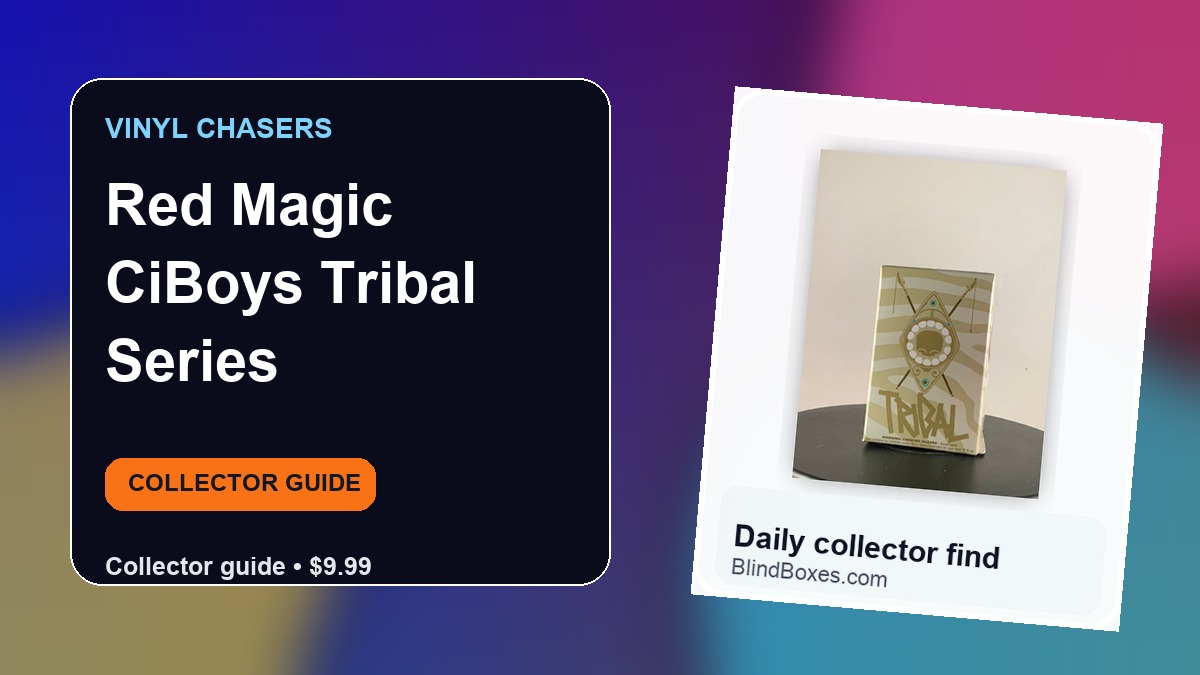
Red Magic’s CiBoys Tribal Series is the kind of designer-toy release that rewards a close look at the box. The cream-and-tan carton carries mask-like graphics, crossed spear or staff forms, and a CiBoys crest, while one side gives collectors something unusually useful: a printed assortment chart. The package also credits LUDO and prints the full name Ludovic Vernhet, tying the visual direction to a named designer rather than leaving the artwork anonymous.
A Red Magic artifact from the early designer-toy web era
The carton identifies Red Magic Holdings Ltd. in Hong Kong, gives the now-defunct redmagic.com.hk address, and carries EAN 4897010932652. An archived Red Magic homepage from January 2008 confirms the company’s web presence during that period, although neither that page nor the photographed carton supplies a precise release date for Tribal Series. That distinction matters: this is clearly an older Red Magic/CiBoys product, but assigning it a specific year without a dated catalog would go beyond the surviving evidence.
The old company context is part of the appeal. CiBoys came from a Hong Kong designer-toy market in which character platforms, compact cartons, and artist-led graphic treatments were central to the experience. Tribal Series reflects that approach throughout its packaging: earth-tone stripes cover the box, the front centers a toothy ceremonial-mask motif, and the side crest repeats lion-like faces around the CiBoys branding.
Ten designs, with the odds printed on the box
This is a sealed blind box, so the individual figure is unknown until opened. The side panel pictures nine named designs and one dark silhouette. The clearly readable names include Deri, Nomi, Hiro, Polka, Go, and Miku; the smaller bottom-row labels read as TO-B, Xete, and TO-FU in the available photograph.
The printed rates create two main tiers. Nomi, Polka, and Go are each marked 12.50%. Deri, Hiro, Miku, TO-B, and TO-FU are each marked 8.33%, while Xete is printed at 8.34% so the displayed decimals reconcile. The mystery silhouette has no visible numeric rate beside it. The nine printed figures total 87.5%, leaving 12.5% for the silhouette if the assortment totals 100%.
That arithmetic prevents a common collector mistake. The silhouetted design is hidden, but the package does not call it a Chase, secret, rare, or exclusive—and the remaining probability is not lower than the 8.33% figures. Accordingly, there is no supported chaser classification here. The silhouette preserves a surprise identity; it is not evidence by itself of a short-packed pull.
What to inspect if you collect sealed examples
A sealed CiBoys box preserves both the random pull and the original graphics, but “sealed” should not be confused with flawless packaging. The product photographs show an intact carton with visible age or shelf handling: the top flap looks slightly bowed, several corners are softened, and the lower edges show light creasing or rubbing. Those cues may be minor for an opener, yet they matter to a collector who displays cartons or wants the cleanest possible archival example.
The base panel is another useful authenticity and condition checkpoint. It should show the Red Magic name, Hong Kong company details, multilingual safety text, “Made in China,” the company web address, and barcode 4897010932652. The carton recommends ages 15 and up and warns about small parts. None of the photographed panels states a figure height, case pack, or limited-edition quantity, so those details should not be assumed.
Who this blind box suits
Tribal Series is most compelling for collectors of early Hong Kong art toys, CiBoys character variations, or packaging-led releases with transparent odds. It is also a more interesting single-box gamble than an assortment with no rate information: the side chart lets you understand the pull structure before deciding whether to keep the carton sealed. Openers get one unknown character from a documented ten-design group; sealed-box collectors retain the Ludo credit, full lineup art, and a surviving piece of Red Magic branding.