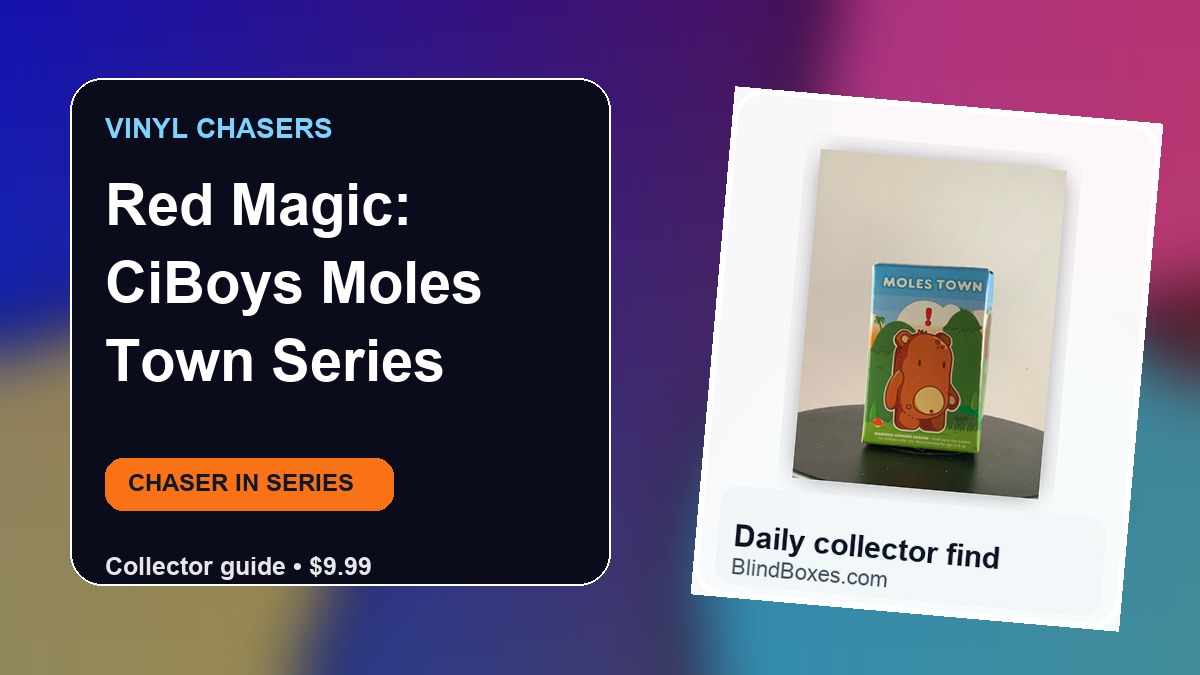
The most useful part of a Moles Town CiBoys box is not the cheerful landscape art on the front—it is the tiny distribution chart on the side. This Red Magic release gives collectors enough information to reconstruct a full 24-box assortment, including nine named characters and a single mystery design. That makes it an unusually readable hunt even though the individual carton keeps the actual figure hidden.

A DGPH world translated into CiBoys
Moles Town was already part of DGPH’s character work by 2006, when the Argentine studio maintained a dedicated Moles Town page on its own site. This boxed interpretation carries both the DGPH name and the CiBoys logo, while the side panel identifies Red Magic and a 2010 copyright. Together, those marks place the release in the international designer-toy ecosystem of the period: DGPH supplies the character world, CiBoys supplies the figure format, and Red Magic handles the Hong Kong release.
The package is an opaque, illustrated carton rather than a window box. Its front shows a round brown character against Moles Town’s green hills, clouds, trees, and mountains; the contents remain concealed. The box also carries an age recommendation of 15 and up, a small-parts warning, a Made in China mark, and barcode 4897010931662. These details are particularly helpful when separating the original release from a loose figure whose name or series connection may have been lost.
The complete 24-box ratio map
The printed lineup accounts for every slot in a 24-box case. Bunder is the most common at 4/24, equivalent to one in six boxes. Three characters sit at 3/24—Badmole, Hambur, and Mastermole—while five are printed at 2/24: Crimole, Wally, Redmole, Lollipop, and Snowmole. The tenth slot is a blue silhouette marked with question marks at just 1/24.
That hidden 1/24 design is the clear collector-described chaser in this assortment: it is materially short-packed, with only one expected slot in the printed case ratio. “Chaser” here describes its rarity and hunt value; the carton does not show an official capital-C Chase designation. The familiar 2/24 figures are not equally scarce—each should appear twice as often as the mystery—and Bunder should appear four times as often.
What the odds mean when buying one box
A single sealed box offers a 1-in-24 printed chance at the mystery character, but the ratios should not be treated as a guarantee for any loose carton. Boxes can be mixed between cases, and a seller may not know where an individual unit originated. The chart is best understood as the manufacturer’s assortment plan, not a promise that every surviving group of 24 boxes remains untouched.
Collectors building a named-character set should also notice that the distribution is deliberately uneven. Bunder is the natural duplicate in a full case, followed by the three 3/24 designs. Redmole or Snowmole may feel harder to find because each occupies only two slots, yet neither is in the same rarity tier as the mystery. That distinction matters when comparing loose-figure prices or trading duplicates.
Package details worth checking
For an unopened example, examine the dark top flap, vertical corners, and clear outer wrapping. The photographed carton is still closed and appears wrapped, but it has visible compression around the upper edge and corners. That kind of shelf wear does not change the printed odds or the concealed contents, though box-focused collectors may weigh it differently from figure collectors.
The strongest identity checks are the Moles Town title on the illustrated face, the CiBoys and DGPH marks, Red Magic’s side-panel information, and the barcode. A genuine box should also show the ten-position ratio panel with totals that add to 24. Because no figure can be seen through the carton, a sealed purchase is fundamentally an odds-based pull rather than a way to select one named mole.