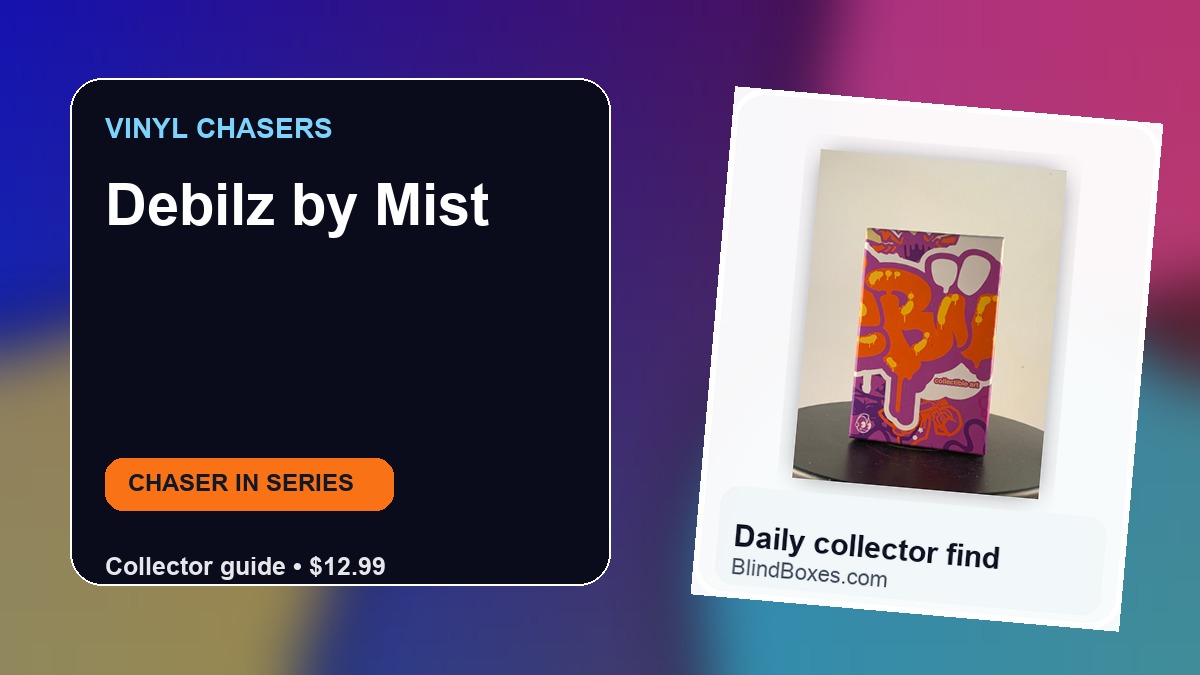
Debilz is not simply another assortment built around a borrowed designer-toy platform. The little demons come from French graffiti artist MIST’s own character world, and the Kidrobot series translates that vocabulary—sharp heads, wicked grins, flames, bones, crowns, and tridents—into a compact blind-box lineup. Released in June 2008, Series 1 consists of 3-inch figures and belongs to the earlier era when artist-led mini series were a central part of Kidrobot collecting.
From a resin character to a Kidrobot series
MIST is the working name of Paris-born artist Guillaume Lemarquier. His background matters here because Debilz predates this mass-produced assortment by a decade: his biography records one of his first resin Debilz characters in 1998. He later founded the Bonus Toyz label in 2001 to produce his own figures and work by selected artists. That chronology makes the 2008 Kidrobot release a later chapter in an established character project rather than a one-off graphic applied to a generic body.
The package reflects that origin. Its orange, purple, yellow, and white graffiti treatment wraps around the carton, while the figures shown on the assortment panel vary dramatically in silhouette. There are horned devils, a top-hatted musician, a skull-headed creature, a crowned character with a wand, trident carriers, and stranger forms that resist an easy description. The shared visual language ties them together more strongly than a uniform sculpt would.
What is in Debilz Series 1?
The Vinyl Creep archive identifies the release as an 11-figure series plus chase variants. Its named catalog includes Raymond, Brigitte, Sylvie, Chantal, Daniel, Alain, Patrick, Gérard, Jean Yves, Jean Phillipe, Jean-Claude, Edouard, and Ulysse, with alternate versions extending the number of collectible outcomes beyond the basic lineup.
That archive records several standard figures at 2/25 or 3/25, while Brigitte and Patrick are each listed at 1/50. It also identifies alternate Jean-Claude and Edouard figures as chase versions and leaves several ratios undisclosed. The photographed carton adds an especially important clue: its lower-right lineup slot is a dark mystery silhouette marked 1/500, while another pictured design uses question marks instead of a disclosed ratio.
Why the odds change the collecting strategy
A 1/50 figure is already short-packed compared with the ordinary named designs. The printed 1/500 mystery is in a different tier entirely. Those documented odds support calling the rare pulls collector-described chasers. That wording is deliberate: scarcity can make a design a chaser even when a package shows its outline or the collector archive identifies the variant. It does not automatically establish an official, capital-C Kidrobot “Chase” designation for every scarce figure.
For a sealed-box buyer, there is no visual shortcut to the character inside. The carton has no display window, and the assortment mixes disclosed designs with hidden or alternate outcomes. A collector targeting one named figure should compare the cost of blind pulls with an authenticated opened example. Someone preserving a sealed 2008 box is collecting a different object: an intact piece of the original assortment, complete with its period package art and printed odds.
Condition details worth checking
The BlindBoxes example is described as new and sealed. Its photographs show a complete upright carton with bright printing, but also visible handling wear: the top flap is slightly bowed, the upper corners show compression, and there are light scuffs and edge marks. None of that identifies the figure, but it matters if the box itself will be displayed. Ask whether seals remain undisturbed, inspect every flap and corner, and distinguish glare on glossy wrapping from actual abrasion. For an opened figure, check that small projecting parts—horns, wands, tridents, ears, and thin limbs—are present and unbroken.
Who should collect it?
Debilz is strongest for collectors interested in the overlap between European graffiti, character design, and the late-2000s designer-vinyl scene. The attraction is not only the remote chance of a 1/500 pull. It is the way one artist’s character history runs from a 1998 resin experiment to a colorful 2008 Kidrobot mini series with a genuinely varied cast. That context gives even the more common figures a specific place in MIST’s toy work.