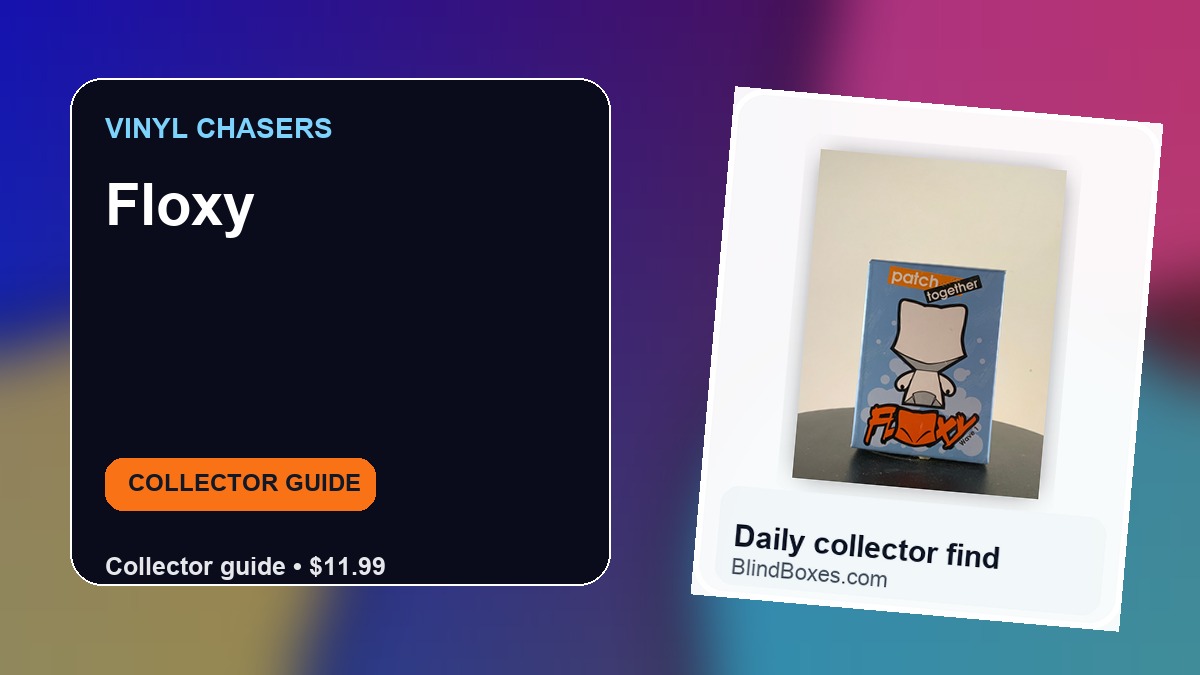
Floxy Series #1 is a small time capsule from the late-2000s designer-vinyl scene: one angular fox platform, a sealed blind-box format, and a group of artists pushing the same silhouette in sharply different directions. Patch Together announced the series on December 31, 2009, and contemporary coverage identified Floxy as an original fox character by SOMA. That context matters because this is not a licensed character assortment or a collection of unrelated miniatures. The appeal is watching one sculpt become nine visibly distinct personalities.

One fox shape, nine radically different treatments
The photographed side panel shows nine designs in a three-by-three grid. Even without printed character names, the assortment’s visual range is easy to read. There are red-and-brown mask graphics, a pale skull face in blue, a yellow-green blocky treatment, a white face with blue-black markings, a green open-mouthed creature, dark pointed-ear designs, and two especially skeletal black-and-white finishes. Because the head is broad and nearly rectangular while the body is compact, most of the artists concentrate their strongest graphics on the face and chest.
Contemporary Vinyl Pulse coverage names Bunka, DUST, Missmonster, Okkle, and VISEone among the artists interpreting SOMA’s platform. The carton itself expands the credit trail with repeated designer names, including SOMA, FLIM, STICK-A-THING, Bunka, DUST, Okkle, VISEone, Missmonster, and Saprophilous. The packaging is therefore more than decoration: for a loose Floxy with no card or box, it is one of the best surviving references for connecting the figure to the wider artist series.
What the box confirms—and what it does not
This is a true sealed blind box: the closed cardboard carton does not reveal which of the nine pictured treatments is inside. The package marks the assortment as a wave and gives Patch Together’s former website, while the safety panel says “For ages 14 and up,” “Made in China,” and warns about small parts. Those details place it squarely in the adult-oriented art-toy category rather than a current mass-market character line.
No pull ratios are printed on the photographed panels, and the available contemporary source does not document a secret, short-packed variant, or official Chase designation. That means none of the nine pictured designs should be called a chaser merely because one looks more dramatic or is harder to find today. For this assortment, scarcity claims need evidence from a case breakdown, printed ratio, or manufacturer record; the box art alone establishes a lineup, not rarity.
How to evaluate a sealed Floxy box
On an older blind box, the carton is part of the collectible. Check the top flap for lifting, resealing residue, or mismatched creases, then inspect the bottom seam and all four corners. The photographed example remains closed and legible, but it shows the kind of shelf wear collectors should expect: slight bowing at the top, softened corners, edge rubbing, and small lower-edge creases. Those flaws do not identify the figure inside, but they should be included when comparing a display-quality box with one intended purely for opening.
Also compare the front and side graphics before buying. An authentic Series #1 carton should carry the Patch Together mark, the blue Floxy artwork, the nine-image lineup panel, and the designer-credit pattern. The broad fox head, tiny body, curled hands, and pointed upper corners are the platform’s defining cues. If buying loose, ask for clear front, back, and foot photos; paint rub on the wide head and loss of small accessories or parts can matter more than the absence of a blind bag.
Why Floxy remains an interesting pull
Floxy is most compelling as an artist-platform set. The nine-panel roster lets a collector choose between completing the full visual experiment and hunting only a favorite contributor’s interpretation. A sealed box preserves the original mystery, while an opened, identified figure makes more sense for anyone targeting a specific color treatment. Either way, the strongest buying decision comes from the documented artist context and the condition of the actual piece—not from an unsupported promise of rarity.