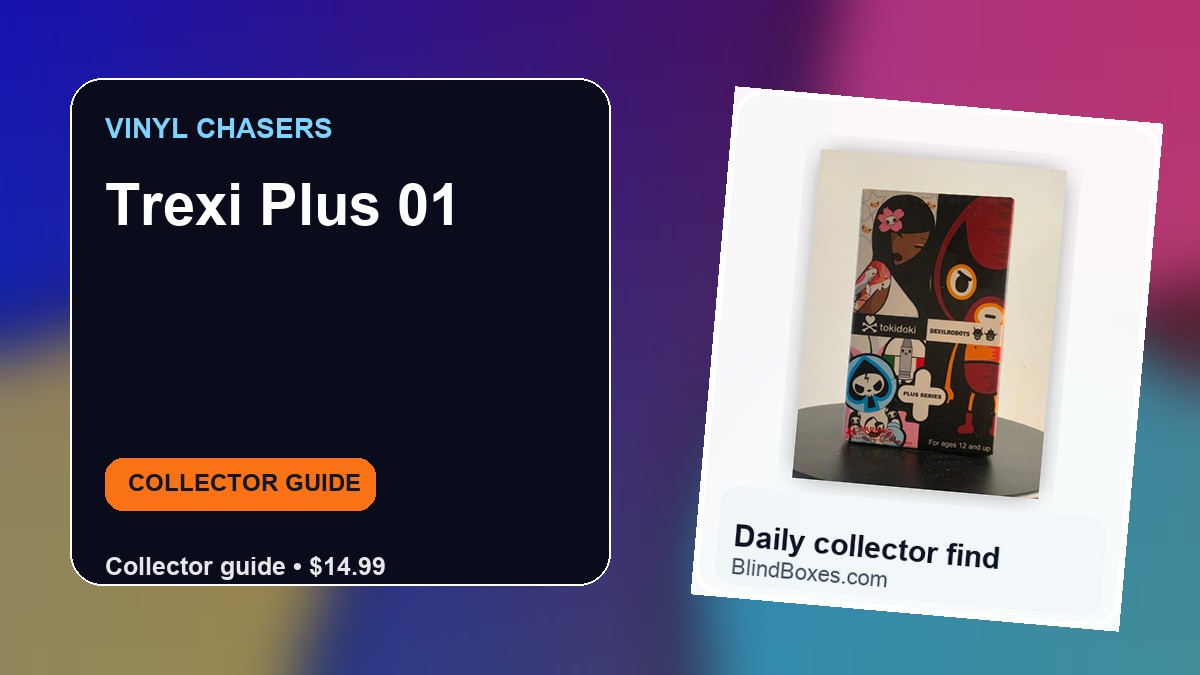
Trexi Plus 01 is a compact time capsule from the first wave of character-driven designer toys. Play Imaginative put two visually different creative worlds on the same sealed blind box: the crowded, candy-colored iconography of tokidoki and the masked Devil Wrestling Fighter cast from Tokyo design team Devilrobots. Rather than treating the collaboration as a quiet logo swap, the package devotes full panels to each artist’s work and lets the contrast become the point.
Two artists, one Trexi package
The front identifies the release as the Trexi Plus Series and places the tokidoki and DEVILROBOTS marks side by side. Simone Legno receives a direct design credit on the tokidoki panel, which also carries a 2005 TOKIDOKI LLC copyright line and the period web address tokidoki.it. That 2005 mark firmly places the artwork in tokidoki’s early era, although a copyright date on packaging should not be mistaken for a guaranteed retail-release date.
For collectors who know tokidoki primarily through later Unicornos and licensed blind boxes, this package shows an earlier visual vocabulary: skull-and-crossbones hearts, hooded figures, headphones, rockets, boxing gloves marked “Love,” and tightly layered character art. Tokidoki’s current company history still identifies Simone Legno as co-founder and chief creative officer, matching the credit printed on this box.
The Devil Wrestling Fighter assortment
The Devilrobots half is unusually informative for a surviving sealed box. One side names five possible masked wrestlers: Red Devil, Mad Purple, Star Green, Blue Crash, and Mr. White. A sixth slot is printed only with a question mark. Another panel labels the concept Devil Wrestling Fighter, credits “Designed by DEVILROBOTS TOKYO JAPAN,” and shows the wrestlers together: horned and star-faced masks, exaggerated teeth, saturated primary colors, and Mr. White’s unmistakable forehead “W.”
That question-mark slot confirms an unrevealed design in the assortment, but the photographed package does not print odds or use “chase,” “secret,” or rarity language. No dependable production ratio is available from the evidence here, so it would be inaccurate to promote the unknown pull as a verified chaser. The useful collector distinction is simple: the box documents five named designs plus one concealed identity, but not how frequently any one appears.
What the sealed box tells a collector
This is an opaque blind box, not a window-boxed known figure. The front carries a small-parts warning and marks the product for ages 12 and up. The BlindBoxes photography covers the illustrated front, both artist panels, the named Devilrobots assortment, and the restrained Trexi end panel. The box is described as mint sealed, and the photographed edges look generally square without obvious crushing or a torn flap. Light surface speckling and glare are visible, so condition-sensitive buyers should still study every full-resolution image rather than assuming modern case-fresh packaging.
The real appeal is the package as a crossover artifact. Its panels preserve the designers’ original URLs, period logos, direct credits, and character names—details often lost when an older blind box is opened and discarded. An opener gets the suspense of the six-slot Devilrobots selection or its tokidoki counterpart; a sealed-box collector gets a small archive of two influential graphic styles sharing the Trexi platform.
Who should consider Trexi Plus 01?
This box makes the most sense for three overlapping collections: early tokidoki, Japanese designer-team work from Devilrobots, and Play Imaginative’s Trexi platform. It is also a strong choice for packaging collectors because all five photographed sides contribute real information rather than repeating one front illustration. At $14.99 while available, it offers an accessible route into a mid-2000s collaboration without pretending that the unprinted odds are known.