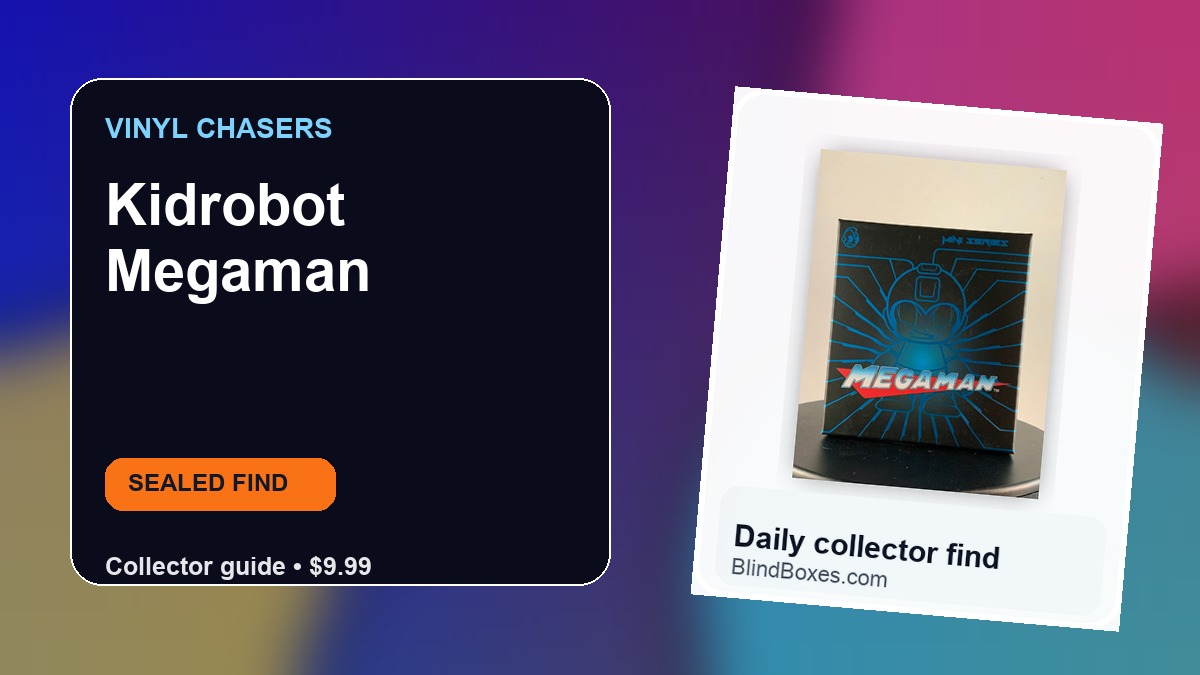
Kidrobot’s Mega Man Mini Series is a compact snapshot of the original game’s cast rather than a broad tour through every Capcom era. Released on August 4, 2015 as part of Kidrobot’s larger Mega Man capsule, the assortment translates Mega Man, his creators and the first six Robot Masters into stylized three-inch vinyl figures. That tight focus is what makes the series coherent: a collector can recognize the 1987 game’s boss roster immediately, while the alternate Mega Man colors give the case some toy-specific variety.
A 2015 capsule built around the first Mega Man
Kidrobot’s own launch announcement placed the Mini Series beside Mega Man keychains and the previously released seven-inch Mega Man and Proto Man figures. Contemporary coverage reported a 20-box case and a $11.99 original single-box price. The available BlindBoxes product is one individual mystery box at $9.99, not a guaranteed character and not a complete case.
The character selection reaches back to the first NES game. The six Robot Masters are Cut Man, Guts Man, Ice Man, Bomb Man, Fire Man and Elec Man. Dr. Light, Dr. Wily and Roll supply the laboratory side of the story, while Mega Man appears in multiple treatments. Yellow Devil rounds out the unmistakably early-series theme. This is useful context for collectors because Proto Man belongs to Kidrobot’s larger 2015 capsule, but he is not one of the clearly documented figures in this three-inch blind-box checklist.
What the photographed box actually tells us
The product photographs show an opaque black carton with blue and red circuit-board graphics, the Mega Man logo, and “Mini Series” branding. More importantly, the two character panels print ratios beneath the illustrated designs. Several core figures are marked 2/20, including the blue Mega Man treatment and multiple Robot Masters; others are marked 1/20, including the green and red Mega Man treatments, Roll, Dr. Light, Dr. Wily and Bomb Man. Those fractions describe the intended case assortment, not the odds of receiving a specific figure from any loose box after cases have been split.
Two pictured positions use ?/?? instead of a numeric ratio: the silhouetted Mega Man design and Yellow Devil. Collectors often treat unknown-ratio pulls as chase-level pieces, and Yellow Devil is commonly described that way in the secondary market. Kidrobot’s photographed package, however, does not publish a numerical short-pack rate or label either one an official “Chase.” The accurate conclusion is simply that their ratios are undisclosed. Buy the mystery, not a promise of rarity.
How the color variants fit the games
The green and red Mega Man figures are more than arbitrary palette swaps. In the original games, Mega Man’s armor changes color when he equips a defeated Robot Master’s weapon. The blind-box series uses that familiar visual language without tying every carton illustration to a printed weapon name. The blue treatment remains the most immediately recognizable Blue Bomber look, while the alternate colors make a display read like a weapon-select screen when grouped with the matching bosses.
That relationship makes this assortment especially satisfying as a small shelf display. Cut Man’s blade-shaped head, Fire Man’s flame crown, Elec Man’s lightning silhouette and Bomb Man’s rounded explosives design remain distinct even after Kidrobot compresses them into a uniform designer-vinyl scale. Dr. Light, Dr. Wily and Roll break up the armored shapes and keep the collection from becoming only a boss lineup.
Box and condition checks for a surviving blind box
The photographed carton appears closed and holds its rectangular shape, with light rubbing and minor compression along some top and lower edges. The images do not prove a factory seal, so “closed box” and “factory sealed” should not be treated as interchangeable. For an older blind box, inspect the top and bottom flaps for retaping, check that the side-ratio panels have not been cut, and ask whether the inner foil remains intact if the carton has already been opened.
Also remember that a loose box may have come from a partially searched or redistributed case. Printed 1/20 and 2/20 ratios are production guidance across cases; they do not guarantee that every remaining box in a broken case retains the original mix. Collectors who care most about character identity may prefer an opened, identified figure. Collectors who value the reveal can keep this one as the format intended.