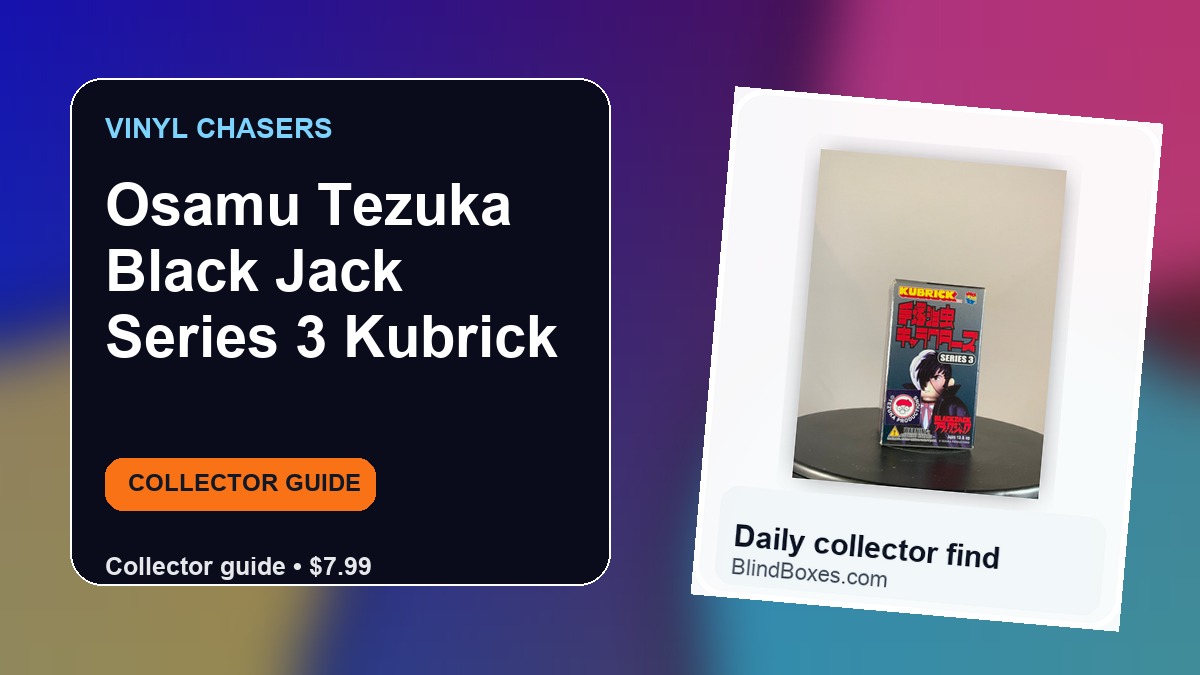
Medicom Toy’s Tezuka Osamu Characters Series 3 brings one of manga’s most recognizable doctors into the compact, block-bodied Kubrick format. This is a sealed blind box with Black Jack artwork, not an opened or identified loose figure. That distinction matters: the front panel establishes the series and the featured character, but it does not reveal which figure is inside.
What the box actually identifies
The photographed front panel reads KUBRICK, 手塚治虫キャラクターズ (Tezuka Osamu Characters), SERIES 3, BLACK JACK, and ブラック・ジャック. It also carries the Tezuka Productions mark and an “Ages 13 & Up” notice. Another photographed panel identifies Medicom Toy Corporation, gives the Medicom website, and shows barcode 4530956170695 along with the code MEDKUB069 and “Made in China.” These markings are useful when comparing a box against loose figures or boxes from other Tezuka assortments.
The striking cover illustration uses Black Jack’s split-color hair, facial scar, dark cloak, and high collar—the features that make him immediately legible even after being translated into Kubrick’s simplified geometry. The package is part of a broader Tezuka character line rather than a box branded only around one manga, which helps explain why individual Series 3 figures can turn up separated from their original cartons.
Why Black Jack fits the Kubrick treatment
Tezuka’s official archive describes Black Jack as a medical drama about a brilliant but unlicensed surgeon. The manga ran in Weekly Shonen Champion from November 19, 1973 through October 14, 1983. Black Jack works from a small clinic with Pinoko, taking cases that other doctors have judged hopeless. His severe silhouette and signature scar give a small designer figure more visual identity than its limited facial detail might suggest.
The same official character guide names several figures central to the manga’s world: Pinoko, Dr. Honma, Kisaragi Kei, and Dr. Kiriko. Pinoko is Black Jack’s assistant and domestic counterpart; Kiriko is the ideological rival whose acceptance of euthanasia conflicts with Black Jack’s determination to save patients. Those relationships are helpful context for collectors encountering named Tezuka Kubricks on the secondary market, but the photographed box does not provide a complete Series 3 checklist or readable assortment ratios. It would be inaccurate to claim a specific enclosed character, secret figure, or short-packed pull from this carton alone.
Sealed-box condition: what the photos show
The carton is presentable but should not be treated as mint packaging. The photographs show rubbing and whitening along several edges, modest corner wear, and light compression around the lower corners. The narrow caution panel remains intact, and no major tear or puncture is visible. The product is described as sealed, although the available angles do not show every wrap seam or closure closely enough to independently certify factory sealing.
For an in-box collector, the important decision is whether the Black Jack artwork and original identification panels outweigh the edge wear. For an opener, the unresolved contents are part of the appeal—but also the risk. The box art should never be taken as proof that a Black Jack figure is inside. There are no supported printed odds in the available photographs, so this product should not be described as containing a chaser or an official manufacturer Chase.
A compact piece of Tezuka collecting history
This box sits at a useful intersection: Medicom’s modular Kubrick design, Tezuka Productions’ character archive, and one of manga’s defining antihero doctors. Its strongest collector features are concrete and visible—the Series 3 branding, Black Jack panel art, Tezuka licensing marks, barcode, and original sealed-box presentation. Buyers who care most about a guaranteed character should seek an opened example; buyers who enjoy period packaging and blind assortment collecting may prefer leaving this one intact.