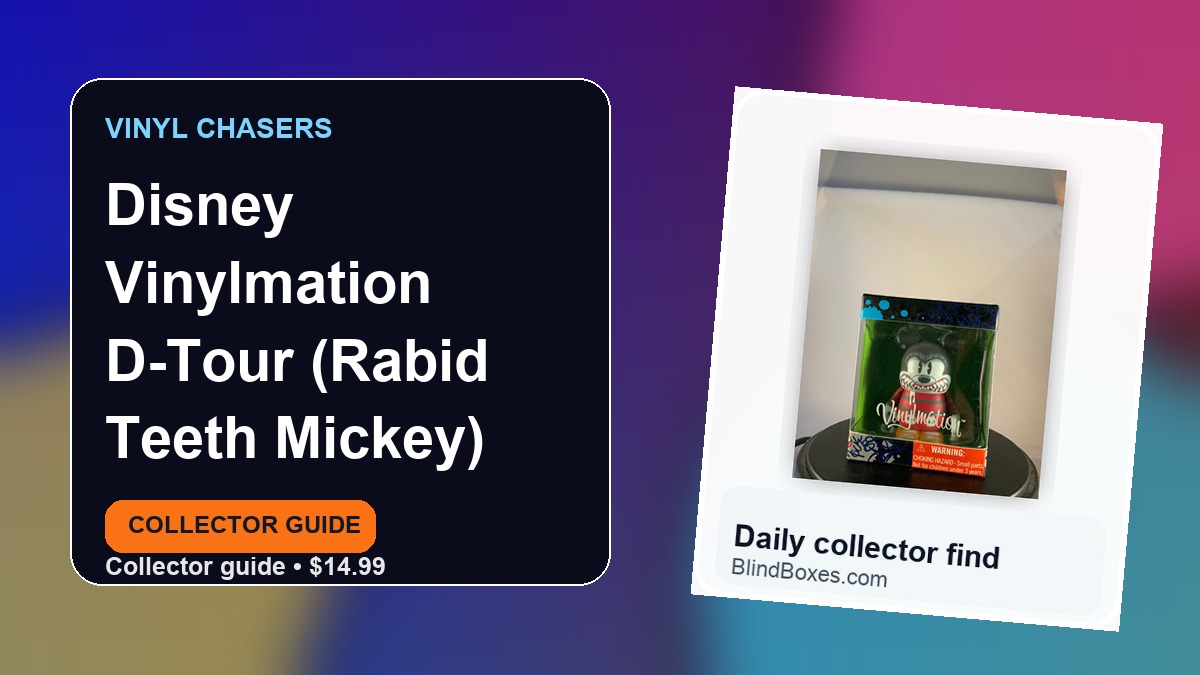
Disney Vinylmation usually begins with a friendly, unmistakable silhouette: Mickey’s round ears, oversized head, compact body and mitten-like hands. D-Tour’s Rabid Teeth Mickey takes that familiar form and pushes it somewhere much rougher. Its gray face is crowded with oversized white teeth, narrowed blue eyes and sketchy black linework; below that, a red patterned torso and warm orange-brown feet finish a deliberately unruly design. The contrast is the point. It is recognizably Mickey-shaped without behaving like a conventional character figure.
A D-Tour figure, not a mystery pull
The package identifies this as a 3-inch Disney Vinylmation collectible figure and places the D-Tour name prominently on its ticket-shaped front graphic. It is a known design in a clear window box, not a sealed blind box whose contents must be discovered after purchase. That distinction matters for collectors: you can evaluate the exact paint application, face alignment and visible condition before adding it to a shelf.
Collector-market archives commonly place Rabid Teeth—also described there as “Weremouse”—in D-Tour Series 1. Those same archives record complete Series 1 groups as seven-figure sets and surface other recurring names such as King Mickey, Green Face/Blue Eyes, Hearts Scribble, Color Doodle and a chalk-rainbow design. Because those names come from secondary-market cataloging rather than a surviving Disney checklist, they are best used as practical search terms, not as proof of official character names.
Why the design stands apart
Vinylmation was introduced in 2008 as a Disney designer-toy line built around standard canvases in several sizes, especially the familiar 3-inch Mickey form. Artists and series could radically change the surface while retaining the silhouette. Rabid Teeth demonstrates that concept unusually well: the ears become broad gray-and-white graphic fields, the face reads like a hand-drawn monster mask, and the red body prevents the monochrome head from flattening into one visual block.
The D-Tour box extends that visual language instead of using generic Disney packaging. Its black ground is covered in paint splashes, layered tags, character outlines and multicolored BLOC28 lettering. “Disney Vinyl,” “3-inch collectible figure,” D-Tour and Vinylmation marks appear on different panels, while the clear window keeps the actual figure central. This is packaging worth retaining because it supplies the line identity and acts as part of the street-art presentation, not merely as shipping protection.
What the original box tells collectors
The rear label identifies Disney Theme Park Merchandise in Lake Buena Vista, marks the piece as made in China, and carries UPC 4 00003 15497 5. It also preserves a printed $12.95 price. That price is historical package evidence, not a statement of present market value; condition, completeness and current demand are separate questions.
The photographed box remains structurally recognizable and the figure is upright behind the window, but the packaging is not pristine. Visible cues include rubbing and scuffing across dark panels, edge and corner wear, some compression or creasing, and marks on the clear plastic that may include light scratches. The distressed graphic print can disguise handling wear, so buyers should compare the close views rather than assuming every pale mark is intentional artwork. The photographs do not establish an untouched factory seal, and no edition-size statement is visible.
How to assess this specific piece
- Check the mouth and eyes: the design depends on crisp tooth boundaries, black facial lines and aligned blue eyes.
- Separate print from wear: paint splatters belong to the box design; crushed corners, rubbed edges and window scratches do not.
- Keep the box with the figure: the D-Tour, BLOC28, Disney Parks and original-price markings provide useful identification context.
- Do not assign chase status without evidence: the available box and research confirm a named Series 1 design, but they do not show printed odds, short-packing or an official Chase designation.
For a collector who likes Vinylmation at its most graphic, Rabid Teeth Mickey is less about traditional character likeness and more about what the Mickey canvas could absorb. Its monster face and purpose-built graffiti package make it a compact snapshot of Disney’s designer-vinyl era.