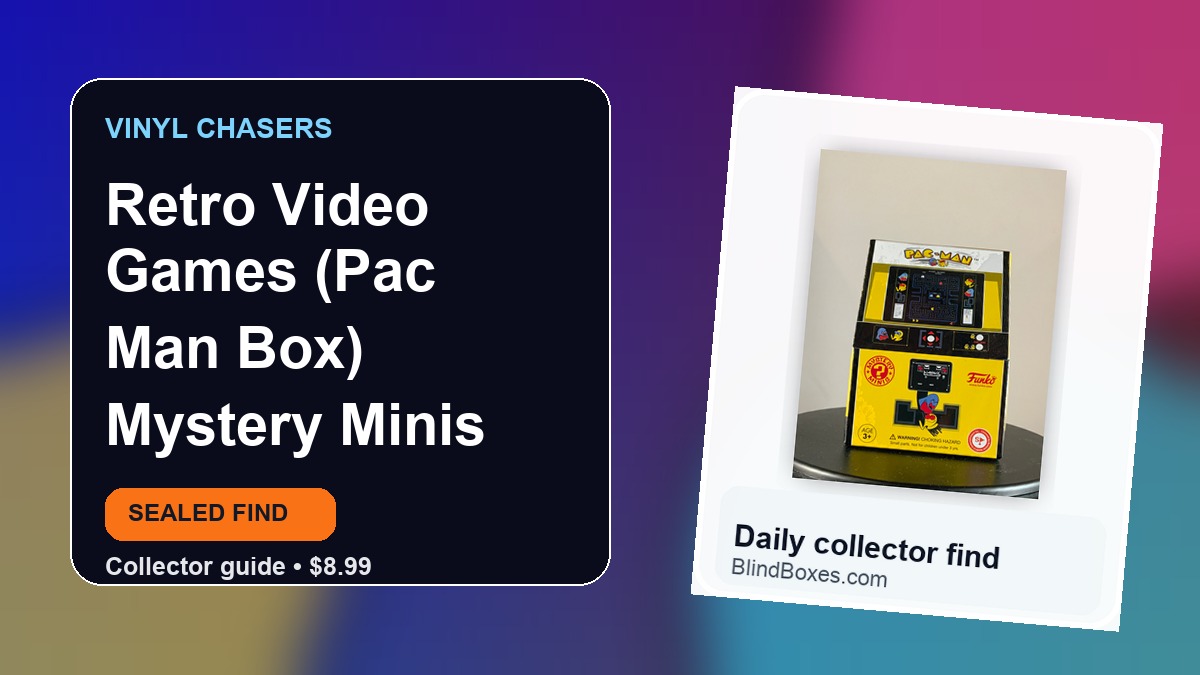
Funko’s Retro Video Games Mystery Minis are a compact crossover arcade: one blind-box series brings together characters from Pac-Man, Ms. Pac-Man, Q*bert, Centipede, Mega Man, Frogger, and Dig Dug. The Pac-Man version is especially displayable because the package is styled like a miniature upright cabinet rather than an ordinary square carton. Its marquee, maze screen, control panel, joystick diagram, and coin-door graphics turn the unopened box into part of the presentation.
The legal panel dates the licensed assortment to the 2017 era, while the official PAC-MAN history places the original arcade game’s Japanese release in July 1980 and its U.S. release that October. That makes this set less about one modern game and more about a shared early-arcade visual language: mazes, sprites, bright primary colors, and instantly readable character silhouettes.
The complete 12-figure arcade roster
The photographed checklist shows 12 designs, arranged as four rows of three:
- Pac-Man, Blinky, and Ms. Pac-Man
- Ms. Pac-Man Ghost, Q*bert, and Coily
- Centipede, Mega Man, and Frogger
- Dig Dug, Pooka, and Fygar
That distribution gives Bandai Namco’s maze and digging games the largest share, but the assortment still reaches across several rights holders. The package credits Bandai Namco Entertainment for Pac-Man, Ms. Pac-Man, and Dig Dug; Columbia Pictures for Q*bert; Capcom for Mega Man; Atari for Centipede; and Konami for Frogger. It is an unusually broad licensed lineup for a single Mystery Minis wave.
Collectors should also note the exact names printed on this package. The back calls the red Pac-Man ghost Blinky, the pink counterpart Ms. Pac-Man Ghost, and the Dig Dug enemy Pooka. Those box names are more useful for cataloging this particular release than later shorthand or alternate spellings.
Why the Pac-Man cabinet does not identify the pull
This product uses the Pac-Man cabinet exterior, but Funko also produced arcade-style cartons based on Centipede, Dig Dug, Frogger, Mega Man, Ms. Pac-Man, and Q*bert. The outer cabinet is a package variant; it does not tell you which character is sealed inside. A Pac-Man box could therefore contain any figure from the 12-character checklist.
That distinction matters for sealed collectors. Someone building a package run can pursue the seven cabinet designs without opening them, while a loose-figure collector is chasing a separate 12-piece character set. A complete cabinet run and a complete figure run are related displays, not the same collecting goal.
Format and rarity: what the evidence actually supports
Funko Mystery Minis are small blind-boxed vinyl figures, generally around 2.5 inches tall. The package itself says “Vinyl Figure” and carries an age 3+ small-parts warning. The front of this Pac-Man box also bears a round Specialty Series Exclusive emblem, an important packaging detail for identifying this release.
Neither the photographed checklist nor the available collector reference prints character ratios for this assortment. No figure is marked as a manufacturer-designated Chase, and the evidence here does not establish a short-packed design. For that reason, it would be misleading to call any member of this roster a chaser solely because Pac-Man, Mega Man, or Q*bert may be especially desirable.
Condition checks for a cabinet-shaped blind box
On this example, the printed carton remains intact, but the photographs show rubbing on the pale marquee, edge and corner wear, side creasing, and some compression around the lower corners. Those flaws are easier to notice on the cabinet silhouette than on a plain cube because the sloped top and dark borders create prominent stress points.
Before buying for sealed display, compare all sides rather than judging only the colorful front. Check the marquee for scuffs, the top flap and sloped shoulders for crushing, the vertical seams for bowing, and the checklist panel for dents. Also confirm that the Specialty Series emblem and Pac-Man cabinet graphics match the version you intend to collect. If your priority is the unknown figure rather than mint packaging, ordinary shelf wear may matter much less.
A focused snapshot of arcade history
The appeal here is the curation. Pac-Man and Ms. Pac-Man anchor the maze-game side; Dig Dug contributes both its hero and two enemies; Q*bert brings Coily; and Centipede, Frogger, and Mega Man broaden the set beyond one company’s catalog. Funko’s super-deformed sculpts give all 12 a consistent scale and style even though their source games used very different hardware and artwork.
For collectors who want one object that reads immediately as “arcade,” the Pac-Man carton is arguably as important as the hidden Mini. Keep it sealed for the miniature-cabinet effect, or open it to work toward the 12-character roster—just remember that the cabinet art never guarantees the pull.