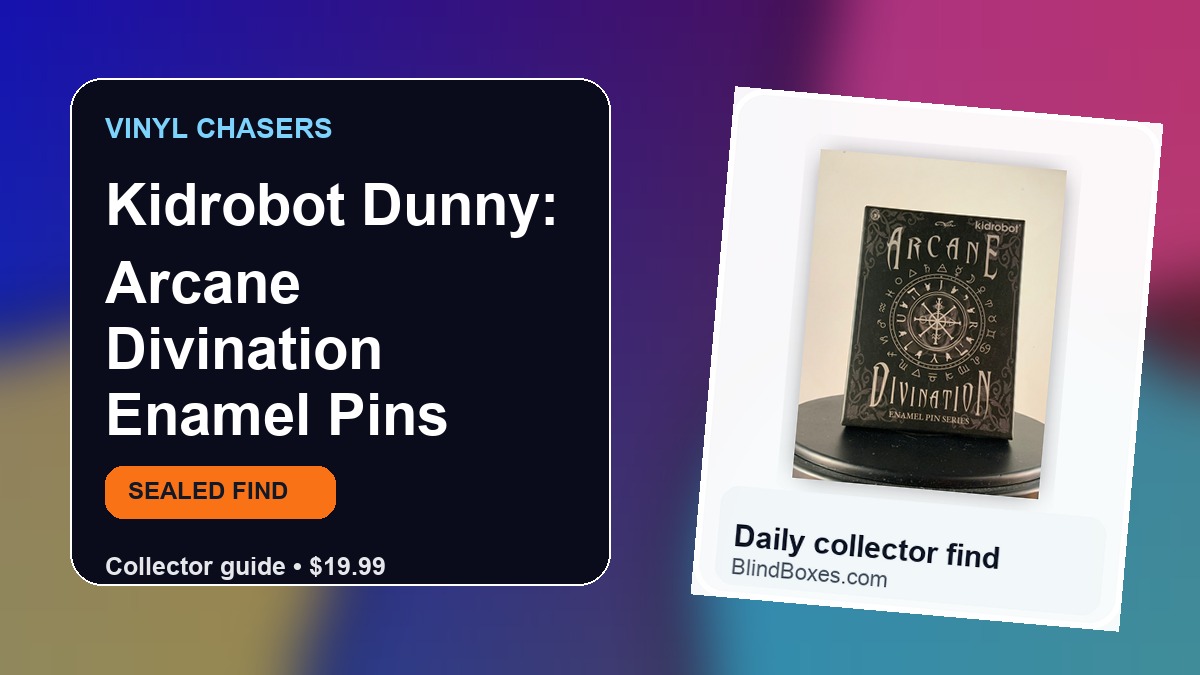
Kidrobot’s Arcane Divination Enamel Pin Series is not a miniature vinyl Dunny assortment. It is a wearable companion to the original tarot-inspired Arcane Divination Dunny series: one random enamel pin per blind box, drawn from 17 named designs. That distinction matters when comparing prices, displays, and odds. The familiar Dunny imagery is present, but the collectible format is a pin rather than a three-inch art toy.
A 2017-era offshoot of the Arcane Divination Dunnys
Kidrobot launched the original Arcane Divination Dunny series on May 12, 2017. Curated by J*RYU, it brought together work by J*RYU, Jon Paul Kaiser, Camilla d’Errico, Godmachine, and Tokyo Jesus, with each design interpreting tarot imagery. The enamel pin follow-up carries that same five-artist roster into a smaller, wearable format. The photographed pin box bears a 2017 copyright, tying it directly to that first Arcane Divination period rather than the later Lost Cards continuation.
The black carton is decorated like an occult chart, with metallic-looking symbols surrounding the Arcane Divination title. The back is much more useful to collectors: it pictures all 17 possibilities and prints the odds beside every name. It also marks the product for ages 15 and up and states “This is not a toy.” The BlindBoxes photographs show a closed box with what appears to be clear wrap, plus light corner and wrap wear but no obvious major crushing. Because the flaps are not shown close-up, collectors should treat the photos as condition evidence—not absolute proof against a careful rewrap.
The complete 17-pin lineup
The assortment divides cleanly into three rarity levels. Four designs are packed at 2/20: Death, Judgement, The Magician, and The Hierophant. Eleven appear at 1/20: Empress, Talisman, Lovers, Temperance, High Priestess, The Fool, The Hanged Man, The Hermit, Clairvoyant, Crystal Ball, and Sun/Moon. The final two—The Devil and Wheel of Fortune—are printed at 1/40.
Those fractions are statistical assortment odds, not a promise that every individual carton or tray follows a perfect sequence. A 2/20 design represents a one-in-ten pull; a 1/20 design represents one in twenty; and either named 1/40 design represents a 2.5% chance from a random box. Retail references for the series also identify a display case as 20 blind boxes. Since each of the two rarest designs is printed at one per 40, a 20-box tray should not be assumed to contain both—or even a guaranteed specific one.
Which pins count as chasers?
The Devil and Wheel of Fortune are materially short-packed relative to the rest of the checklist. It is therefore accurate to describe them in collector language as chaser or chase-level pulls. Their artwork being revealed on the box does not make them less rare. However, the package does not present either one as an official capital-C Kidrobot “Chase,” so that manufacturer designation should not be added. Here, “chaser” describes the documented 1/40 distribution, not simply a favorite design.
How to collect this series intelligently
For a collector who wants the visual variety rather than a complete set, random boxes preserve the intended reveal and offer access to all five artists’ tarot vocabulary. Completionists should approach the math differently. With 17 designs but a 20-box case, duplicates are built into the published distribution: the four 2/20 pins consume eight statistical slots, while the pair of 1/40 pins extends beyond one tray’s scale. Trading for named 1/20 designs and buying the two 1/40 pulls individually can be more controlled than chasing the final gaps through sealed boxes.
Opened examples should ideally retain the foil or inner packaging, the checklist box, and the pin back. For sealed-box collectors, inspect corner compression, flap disturbance, wrap seams, and punctures. For loose-pin collectors, focus on bent posts, missing backs, enamel chips, deep scratches, and tarnish. The named tarot design and printed odds are more meaningful identification details than the generic Dunny silhouette alone.