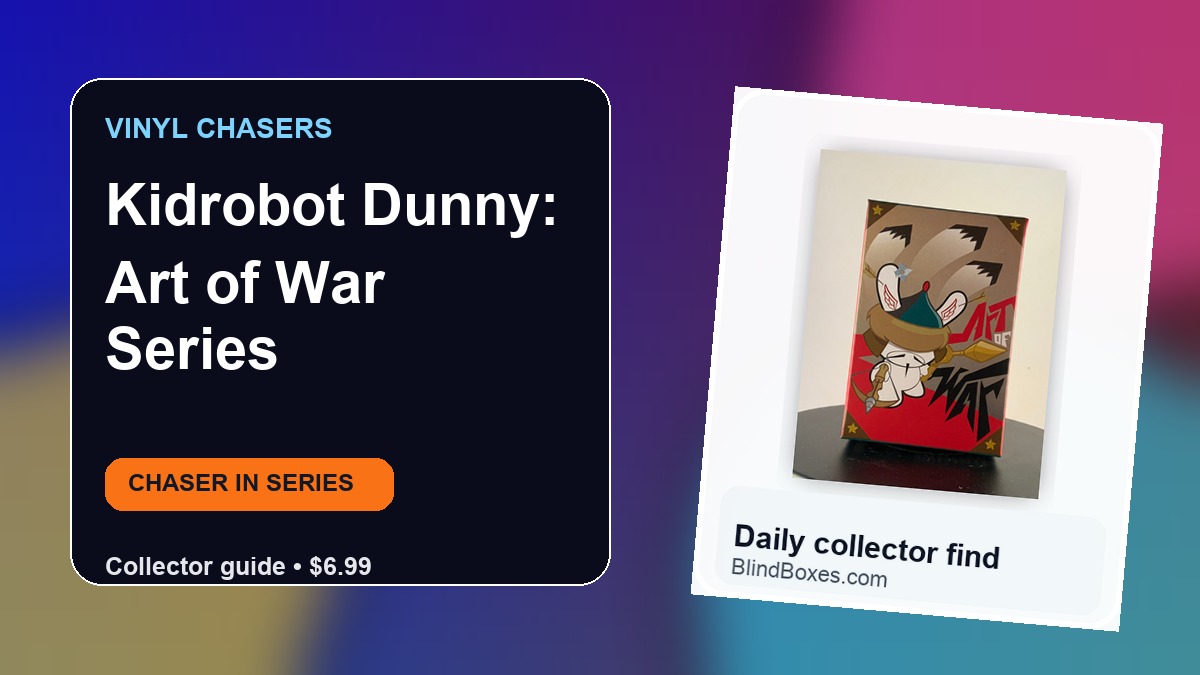
Kidrobot’s Dunny 2014: Art of War treats the rabbit-eared vinyl platform like a miniature battlefield. Rather than building the series around one character license, Kidrobot asked 14 artists to interpret warfare, strategy, uniforms, weapons, propaganda, and deception. The photographed blind box preserves the most useful evidence for collectors: two illustrated assortment panels with printed ratios, including several genuinely short-packed designs and two mystery slots whose odds remain hidden.

A June 2014 release by 14 artists
Kidrobot’s official preview dated the release to Friday, June 27, 2014, at an original price of $11.99 per blind box. The announced artist roster was Colus, Devious, Frank Kozik, ilovedust, Igor Ventura, Kano, Luihz Unreal, Huck Gee, DrilOne, Sergio Mancini, Patricio Oliver, JPK, Sam Fout, and Shok1. Kidrobot framed their designs as lessons or chapters inspired by strategic themes such as “The Calculations,” “Illusion & Reality,” and “Vinyl Attack.”
That 14-artist roster should not be confused with the number of illustrated outcomes on the box. Across the two photographed checklist panels there are 17 positions, including color treatments, variations, and two black mystery silhouettes. One artist can therefore account for more than one pictured outcome. Without a readable name key on this exact package, matching every tiny illustration to an artist would be guesswork; the official roster and the printed probabilities are the defensible facts.
Reading the printed Art of War odds
The two package panels show a wide rarity spread. The readable known ratios break down as follows:
- Three designs at 2/20, equivalent to 1/10.
- Four designs at 1/20.
- Three designs at 3/40.
- Two designs at 1/40.
- Two designs at 1/60, the scarcest probabilities printed for named illustrations.
- Two mystery silhouettes marked ?/??, one on each panel.
The known ratios add up to 14/15 of the advertised probability. That leaves a combined 1/15 for the two concealed mystery positions, but the box does not say how that remainder is divided. It would be tempting to call them 1/30 each; that is not printed evidence, so collectors should preserve them as unknown rather than manufacture exact odds.


Which pulls count as chasers?
The two 1/60 designs are clear collector-described chasers: each is materially short-packed relative to the common 2/20 figures. The 1/40 designs also sit in chase-level territory, while the 3/40 and 1/20 figures form intermediate tiers. This is collector rarity language, not proof that Kidrobot officially branded any individual package illustration with a capital-C “Chase” label.
Kidrobot also announced a case-exclusive figure as a gift with purchase for full cases and said it was required for a complete set. That bonus is separate from the ordinary single-box gamble. A surviving loose case exclusive should be cataloged as a distribution bonus, not assigned one of the ratios printed on the retail blind-box panels.
What to inspect on this sealed example
The current BlindBoxes product is one available sealed blind box, not a case and not a guaranteed design. Its photographs show closed flaps and readable assortment panels, with rubbing along edges and corners, bowing at the top rim, and light creasing. Those details matter because the box art and odds chart are part of the appeal for an older designer-toy release. Buyers who prioritize packaging should compare every flap, corner, and wrap seam in the exact photographs rather than assuming “sealed” means mint.
For an opener, the odds make this a more structured hunt than a modern equal-ratio assortment. For a box collector, the military-poster treatment, red probability panels, and intact ratio map give the package documentary value even before the figure is revealed.
Check the sealed Art of War Dunny at BlindBoxes.com
Sources
- Kidrobot: Product Preview — Dunny 2014 Art of War — official release date, original price, 14-artist roster, themes, and case-exclusive promotion.
- BlindBoxes: Kidrobot Dunny Art of War Series — current availability, price, sealed format, and exact product photographs.
- First photographed odds panel and second photographed odds panel — illustrated outcomes, mystery slots, and printed ratios.