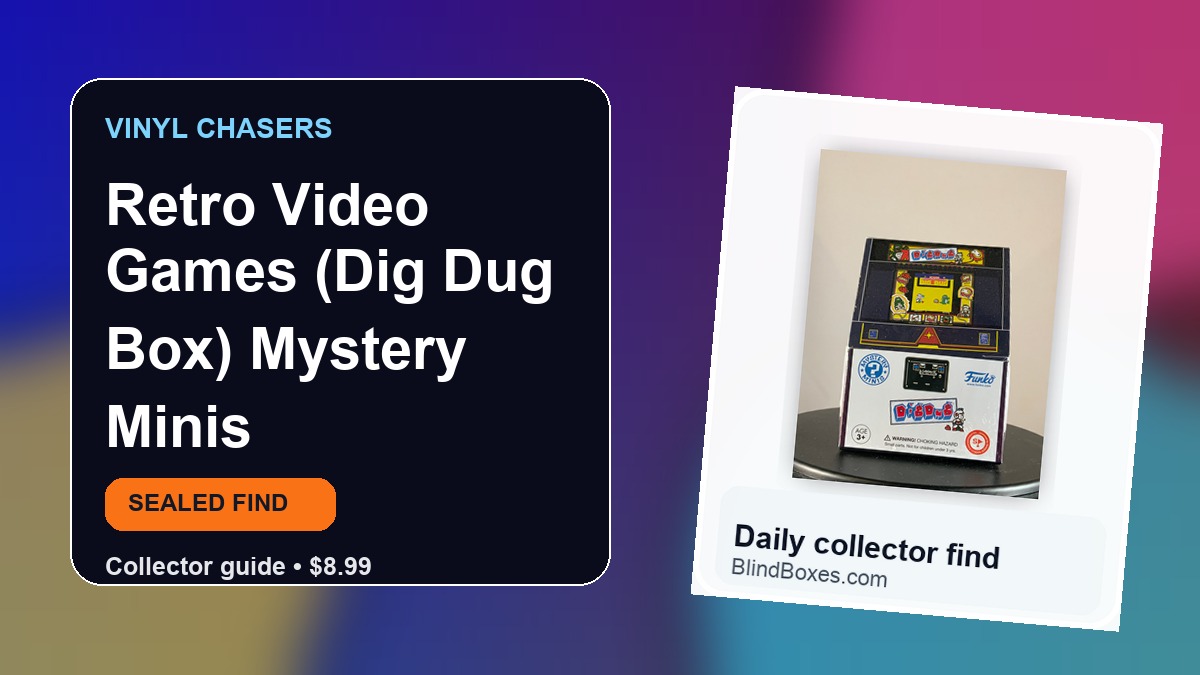
Funko’s Retro Video Games Mystery Minis turn the outside of a blind box into part of the arcade tribute. This example uses the Dig Dug cabinet design: a tall, angled carton styled like a miniature coin-op machine, complete with a Dig Dug marquee, pixel-inspired screen art, control-panel graphics, and the Mystery Minis question-mark badge. It is more elaborate than an ordinary rectangular blind box—and that creates an extra collecting wrinkle.
The cabinet printed on the package does not identify the vinyl figure inside. A Dig Dug box may still contain Pac-Man, Frogger, Mega Man, Q*bert, or another character from the assortment. Collectors therefore have two separate goals to consider: assembling the 12-figure lineup and, if desired, preserving the different arcade-cabinet box designs.

The printed 12-character arcade lineup
The photographed checklist groups characters from several classic game families rather than building the assortment around one license. Read directly from the package, the 12 designs are:
- Pac-Man: Pac-Man and Blinky
- Ms. Pac-Man: Ms. Pac-Man and Ms. Pac-Man Ghost
- Q*bert: Q*bert and Coily
- Dig Dug: Dig Dug, Pooka, and Fygar
- Standalone representatives: Centipede, Mega Man, and Frogger
That breakdown is useful because some informal checklists rename the ghosts by color or nickname. The package itself prints Blinky for the red Pac-Man ghost and Ms. Pac-Man Ghost for the pink ghost. Likewise, the Dig Dug enemy is printed as Pooka. For cataloging a loose mini, the names on the box are the cleanest reference.
A 2017-era crossover, documented on the box
The legal panel ties the assortment to Bandai Namco for Pac-Man, Ms. Pac-Man, and Dig Dug; Columbia Pictures for Q*bert; Capcom for Mega Man; Atari for Centipede; and Konami for Frogger. It also carries 2017 legal notices for Q*bert and Atari. That makes “2017-era” the careful way to date this package from the physical evidence without turning a copyright line into a more exact street-date claim.
The crossover also captures several different branches of early arcade history. Dig Dug, Pac-Man, Ms. Pac-Man, Frogger, Q*bert, and Centipede all become recognizable through simple silhouettes and color blocking, while Mega Man expands the theme beyond a literal arcade-only checklist. For collectors, that variety is the assortment’s main appeal: it reads like a compact shelf of coin-op memories rather than a single-game character wave.
Why the Dig Dug box matters
The broader product evidence identifies cabinet packages based on Centipede, Dig Dug, Frogger, Mega Man, Pac-Man, Ms. Pac-Man, and Q*bert. Those are packaging variants, not promises about the pull. The Dig Dug version is particularly easy to recognize from its red-and-blue logo placard, little underground enemies, green Fygar artwork, and the miner hero near the bottom of the illustrated screen.
If you collect the packaging, examine more than the front logo. Arcade-shaped cartons have extra angled edges that can show rubbing, whitening, or compression. The product photographs show visible corner and edge wear, plus light surface scuffing. They show a closed package, but no unmistakable factory seal is visible from the photographed angles, so “closed” and “factory sealed” should not be treated as interchangeable condition grades. Ask for top- and bottom-flap photos when seal status matters.
What the box does—and does not—say about rarity
The pictured checklist names all 12 figures, but it does not print pull ratios beside them. No retailer-exclusive sticker or alternate-assortment label is visible either. Without documented odds, there is no sound basis for calling one of these figures short-packed or describing it as a collector chaser. A favorite character may be desirable, but desirability alone is not rarity.
That makes this Dig Dug box best suited to one of three collecting approaches: keeping an arcade-shaped package intact as a display piece, opening it for one random figure from the printed lineup, or pairing an empty Dig Dug carton with a correctly identified loose mini. Whichever route you choose, record the box design separately from the figure; treating the cabinet art as a contents label is the easiest way to miscatalog this release.