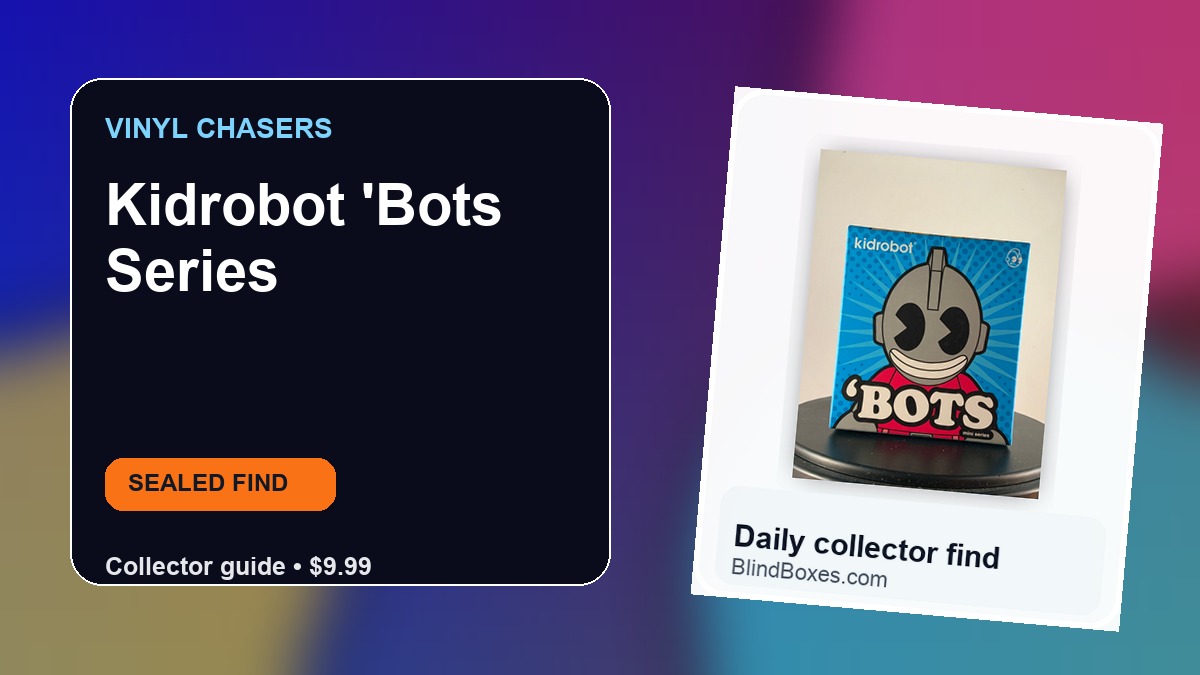
Kidrobot’s ’Bots Mini Series is a compact time capsule from the company’s early-2010s designer-toy era. Instead of handing one blank platform to a roster of guest artists, this release recast Kidrobot’s familiar helmeted icon as an entire neighborhood of characters. The result is an 11-design assortment of three-inch vinyl figures whose clothes, props, and attitudes do most of the storytelling.
Kidrobot previewed the series on September 22, 2011 and scheduled it for October 6, 2011. The original price was $9.95 per blind box. Each figure articulates at the head and arms, a useful detail for collectors who want more than a static shelf pose from a small mascot figure.
One mascot, 11 very different personas
The shared sculpt keeps the series visually coherent: a broad grin, dark notched eyes, and the ridged robot helmet appear throughout. Costumes then push the ’Bot into streetwear, sports, and comic archetypes. Kidrobot’s own preview specifically names KidGangster, KidVandal, KidPunk, KidPrisoner, and KidBomber, describing a broader mix that includes gangsters, punks, and boxers.
The photographed box panels show all 11 outcomes. Among the most recognizable are a mohawked punk, a plaid-shirted gangster posed with a teddy bear, a black-and-white striped prisoner, two basketball players, a bear-suited figure, and an orange figure wearing a paper bag over its head. Props such as a basketball, teddy bear, staff, and handheld gear give the silhouettes more variety than their common base body might suggest.
The printed odds tell the real collecting story
This package does something especially valuable for an older blind-box release: it preserves the full odds map. Seven designs are comparatively accessible, with six printed at 2/20 and the teddy-bear gangster at 3/20. A green armored figure is marked 5/40. The remaining three are shorter packed: the red basketball player at 5/80, the paper-bag figure at 3/80, and the striped prisoner at just 1/40.
Those fractions describe the production assortment, not a promise for any one box or even any one case. A 1/40 rate is 2.5 percent, so a 20-box case would average only half of a prisoner figure across many cases. The 3/80 paper-bag design works out to 3.75 percent. Both reasonably qualify as collector-described chasers because they are materially short-packed, but there is no need to turn that into an unsupported claim that Kidrobot officially branded either one as a capital-C Chase.
The odds also make the series more nuanced than a simple “common versus rare” split. The 5/80 basketball figure is scarcer than the standard 2/20 characters, while the 5/40 green figure is slightly more frequent. For collectors building a loose set, checking the number printed beside the exact costume is more reliable than judging rarity from how elaborate a prop looks.
What to inspect on a 2011 blind box
For a sealed example, condition begins with the carton. The available product photos show the blue radial-ray box upright and complete, with closed flaps and modest edge or corner wear. The top edge appears slightly bowed in places. No clear factory tape or shrink wrap is visible in the photographs, so “closed” should not automatically be treated as proof of an untouched factory seal.
Collectors who care about box condition should compare all panels for flap lifting, compression, whitening along folds, and tears around the top tab. The side-panel lineup is part of the artifact here: it records the character art and exact odds, so abrasion across those tiny fractions matters more than it would on generic packaging. If buying to open, remember that age can also affect inner bags, small accessories, and paint surfaces even when the outer box presents well.
Why ’Bots still stands apart
The attraction is not a licensed character or a famous outside artist roster. It is Kidrobot turning its own visual identity into a miniature cast, then using costume and prop design to make one mascot read as a punk, baller, vandal, prisoner, or gangster. That makes ’Bots an unusually direct piece of Kidrobot brand history—and the printed 2011 assortment gives today’s collectors a concrete roadmap rather than folklore about which pulls are actually scarce.